What Is an AI Agent? Types, Examples and Top Platforms (2026)
What is an AI agent? A plain-English guide to agents in artificial intelligence: how they work, the main types, examples and top AI agent platforms.
Quick answer
An AI agent is software that uses an AI model to work toward a goal on its own: it plans steps, uses tools such as a browser or your apps, checks the results and keeps going until the task is done, usually with your approval at key points. Popular examples include Manus, ChatGPT Atlas, Devin and Lindy.
A chatbot answers your question. An AI agent takes action. That is the simplest way to understand an agent in artificial intelligence: instead of replying with text, it can search the web, fill in forms, write and run code, send emails or update a CRM to complete a goal.
AI agents moved from research demos to everyday products in 2025 and 2026. This guide explains how they work, the main types and the AI agent platforms businesses use today.
AI agent platforms and frameworks at a glance
| # | Tool | Best for | Free option |
|---|---|---|---|
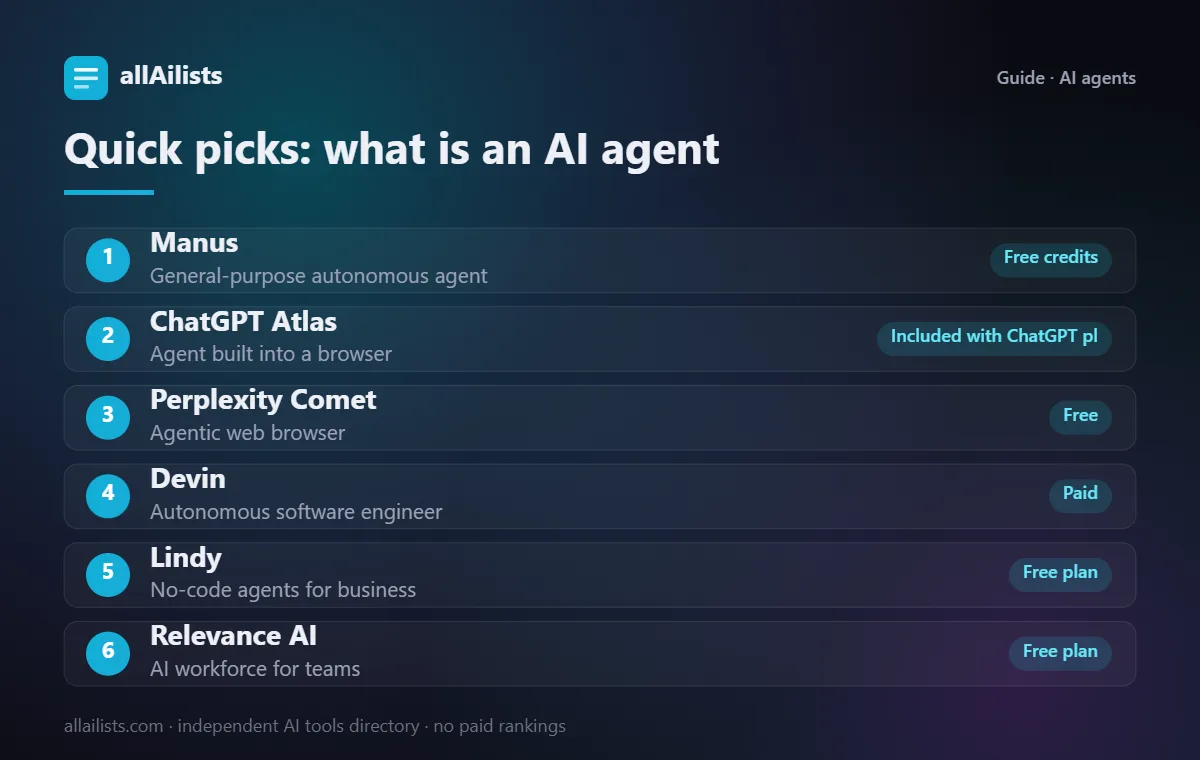
| 1 | Manus | General-purpose autonomous agent | Free credits |
| 2 | ChatGPT Atlas | Agent built into a browser | Included with ChatGPT plans |
| 3 | Perplexity Comet | Agentic web browser | Free |
| 4 | Devin | Autonomous software engineer | Paid |
| 5 | Lindy | No-code agents for business | Free plan |
| 6 | Relevance AI | AI workforce for teams | Free plan |
| 7 | Microsoft Copilot Studio | Agents for Microsoft 365 | Paid |
| 8 | Salesforce Agentforce | Agents inside Salesforce | Paid |
| 9 | LangGraph | Framework for building agents | Free, open source |
| 10 | CrewAI | Multi-agent framework | Free, open source |
| 11 | OpenAI Agents SDK | Building agents with OpenAI | Free SDK (pay for API) |
| 12 | Model Context Protocol | Connecting agents to tools | Open standard |
Free options change often. Details reflect each product's public plans as of November 2026; always confirm on the official site.
How we picked these tools
Every tool here is listed in the allAilists directory, which we re-check every month for products that shut down, rebrand or change direction. We favor established products with a clear use case, add strong newcomers where they fill a gap, and note where the free option is limited. Nobody paid to be included and we do not use affiliate rankings.
Popular AI agent platforms and frameworks
1. Manus: general-purpose autonomous agent
Manus takes a goal, plans the steps and works through research, documents and web tasks on its own.
2. ChatGPT Atlas: agent built into a browser
ChatGPT Atlas is OpenAI's browser with an agent that can navigate sites and complete tasks for you.
3. Perplexity Comet: agentic web browser
Comet from Perplexity is a browser with an AI assistant that can research and act on pages.
4. Devin: autonomous software engineer
Devin from Cognition takes coding tickets end to end: planning, coding, testing and opening pull requests.
5. Lindy: no-code agents for business
Lindy lets you build agents that handle email, meetings, scheduling and operations without code.
6. Relevance AI: AI workforce for teams
Relevance AI is a platform for building teams of agents for sales, research and operations.
7. Microsoft Copilot Studio: agents for Microsoft 365
Copilot Studio lets companies build agents that work across Microsoft 365, Teams and business data.
8. Salesforce Agentforce: agents inside Salesforce
Agentforce adds autonomous agents for service, sales and marketing inside Salesforce.
9. LangGraph: framework for building agents
LangGraph helps developers build reliable, stateful agent workflows in code.
10. CrewAI: multi-agent framework
CrewAI organizes several agents with roles that collaborate on a task.
11. OpenAI Agents SDK: building agents with OpenAI
The OpenAI Agents SDK provides building blocks for tools, handoffs and guardrails.
12. Model Context Protocol: connecting agents to tools
Model Context Protocol (MCP) is an open standard that lets AI agents connect to apps, files and data sources in a consistent way.
How do AI agents work?
Most agents follow a loop: understand the goal, plan the next step, use a tool (a browser, an API, a code runner or your apps), look at the result, and decide what to do next. Memory lets them keep track of progress, and guardrails decide when they must ask a human for approval.
Types of AI agents
- Assistant agents work alongside you in a chat or browser, like ChatGPT Atlas or Comet.
- Task agents complete a defined job end to end, like Devin for code or Manus for research.
- Workflow agents run inside business systems, like Lindy, Agentforce or Copilot Studio.
- Voice agents answer and make phone calls; see AI Voice Agents & Receptionists.
- Multi-agent systems split work between several specialised agents, often built with frameworks like CrewAI or LangGraph.
How to create an AI agent
Non-developers can start with a no-code platform such as Lindy, Relevance AI or the agent features in Zapier: describe the goal, connect the apps it may use, set approval steps, then test on low-risk tasks. Developers typically use a framework such as LangGraph or the OpenAI Agents SDK with a model from an AI model platform and connect tools through MCP.
AI agents for business: where to start
- Pick one repetitive, well-defined task with a clear success measure.
- Start with read-only access, then add actions with human approval.
- Log what the agent does so you can review and improve it.
- Compare a no-code platform with your existing tools' built-in agents before building from scratch.